 Just back from a trip to Germany. Installed a new computersystem and put it online.....
Wednesday, April 01, 2009
Computer system installed and online
Just back from a trip to Germany. Installed a new computersystem and put it online.....

Saturday, March 28, 2009
Sunday, March 22, 2009
Observation night 21th March 2009 Virgo cluster and Coma Berenices
Observation night 21th March 2009: Virgo cluster and Coma Berenices:
Instrument: 200mmF5 newton. location: backyard.
As a test I started with Saturn at 200x: nog bad.
After that M51 at 125x. Visible als 2 bright dots with a weak nebula around it.
M53, bright globular cluster. Periphery more and more stars visible with the 8mm.
Then I tried a weaker galaxy:
M64, visible as a bright center with a big and weak nebula around it in the 8mm.
M3, beautiful globular cluster. It is a joy to view this object. Many starts of about the same magnitude in the 8mm.
Ok, the seeing was acceptable enough to initiate the attack on the Virgo cluster:
M49, weak galaxy. Bright center with a weak nebula around it in the 8mm.
M58, relatively weak galaxy. Bright center with a very weak nebula in the 8mm.
M59, even weaker galaxy. The bright center is just visible. Periphery necessary for the nebula in 8mm.
M60, directly visible galaxy with brighter center. Directly visible in the 8mm.
M61, periphery jsut visible galaxy. Not really sure. Visible as a dot with a slightly more bright center in the 8mm.
M84, galaxy with bright center and weak nebula around it in the 8mm.
M86, galaxy with a nebula that is very big. Only visible periphery in the 8mm.
M88, galaxy without bright center. By looking periphery a very weak nebula is visible in the 8mm.
M89, small galaxy. Visible as a small bright dot. Periphery the nebula becomes slightly bigger in the 8mm.
M90, very wek galaxy, periphery just visible.
Then the biggest achievement:
M91, periphery -just- visible. By far the weakest object of the evening. Doubtful in the 8mm. My first mag. 10+ object ever. And
that from the backyard!
M98, periphery visible as a weak and elongated galaxy. Relatively big. Also very weak, but not as weak as M91. Used 8mm.
M104, Sombrero galaxy: very beatiful edge on. Very bright in the 8mm.
M102, very bright and elongated galaxy. No bright center. Best in 8mm.
After that a few easier ones:
M13, really beautiful and big globula cluster. Back after the winter. Very rich with many stars in the 8mm.
M92, globular cluster that extends very far. Much smaller than M13. Very nice in the 8mm.
After that some beautiful NGC's that were already on my todo list for a long time:
NGC4565, very beautiful edge-on. Bright in the 8mm. Visible as a smear. Fits 8mm fov nicely.
NGC4631, very beautiful and very big edge-on. Does not fit 8mm fov. Therefore used 21mm. Visible as a big thin smear.
NGC4216, almost edge on. Bright center. Best in 8mm.
After that the Leo galaxies:
M65, bright center with a weak nebula around it in the 8mm.
M66, weak galaxy with slightly brighter center. Periphery necessary to see the nebula in the 8mm.
And after that:
M105, M95 and M96 all together in the fov of the 21mm. M105 is relatively weak, the other 2 bright.
This was a nice observation night. I have seen 14 new Messier objects this night!!
Instrument: 200mmF5 newton. location: backyard.
As a test I started with Saturn at 200x: nog bad.
After that M51 at 125x. Visible als 2 bright dots with a weak nebula around it.
M53, bright globular cluster. Periphery more and more stars visible with the 8mm.
Then I tried a weaker galaxy:
M64, visible as a bright center with a big and weak nebula around it in the 8mm.
M3, beautiful globular cluster. It is a joy to view this object. Many starts of about the same magnitude in the 8mm.
Ok, the seeing was acceptable enough to initiate the attack on the Virgo cluster:
M49, weak galaxy. Bright center with a weak nebula around it in the 8mm.
M58, relatively weak galaxy. Bright center with a very weak nebula in the 8mm.
M59, even weaker galaxy. The bright center is just visible. Periphery necessary for the nebula in 8mm.
M60, directly visible galaxy with brighter center. Directly visible in the 8mm.
M61, periphery jsut visible galaxy. Not really sure. Visible as a dot with a slightly more bright center in the 8mm.
M84, galaxy with bright center and weak nebula around it in the 8mm.
M86, galaxy with a nebula that is very big. Only visible periphery in the 8mm.
M88, galaxy without bright center. By looking periphery a very weak nebula is visible in the 8mm.
M89, small galaxy. Visible as a small bright dot. Periphery the nebula becomes slightly bigger in the 8mm.
M90, very wek galaxy, periphery just visible.
Then the biggest achievement:
M91, periphery -just- visible. By far the weakest object of the evening. Doubtful in the 8mm. My first mag. 10+ object ever. And
that from the backyard!
M98, periphery visible as a weak and elongated galaxy. Relatively big. Also very weak, but not as weak as M91. Used 8mm.
M104, Sombrero galaxy: very beatiful edge on. Very bright in the 8mm.
M102, very bright and elongated galaxy. No bright center. Best in 8mm.
After that a few easier ones:
M13, really beautiful and big globula cluster. Back after the winter. Very rich with many stars in the 8mm.
M92, globular cluster that extends very far. Much smaller than M13. Very nice in the 8mm.
After that some beautiful NGC's that were already on my todo list for a long time:
NGC4565, very beautiful edge-on. Bright in the 8mm. Visible as a smear. Fits 8mm fov nicely.
NGC4631, very beautiful and very big edge-on. Does not fit 8mm fov. Therefore used 21mm. Visible as a big thin smear.
NGC4216, almost edge on. Bright center. Best in 8mm.
After that the Leo galaxies:
M65, bright center with a weak nebula around it in the 8mm.
M66, weak galaxy with slightly brighter center. Periphery necessary to see the nebula in the 8mm.
And after that:
M105, M95 and M96 all together in the fov of the 21mm. M105 is relatively weak, the other 2 bright.
This was a nice observation night. I have seen 14 new Messier objects this night!!
Monday, March 16, 2009
Gig at "De Klomp" in Etten-Leur
Last sunday we had to play in a very nice small music cafe in Etten-Leur. We had a lot of fun and good reactions afterwards......It was a joy to play over there.
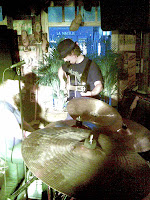 Here Patrick is layin' it down.
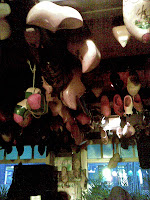 The whole ceiling of the small pub is full with wooden shoes.
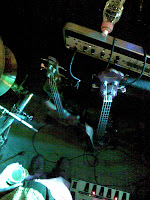 This is me when viewing down on my 2 basses......You already see the floor-switchboard of our singer/guitarist. That left me about 30square cm to stand on......
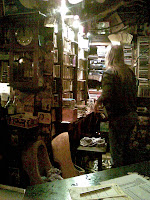 Here the pub-owner is putting on some real rock-stuff!
 Here Patrick is layin' it down.
 The whole ceiling of the small pub is full with wooden shoes.
 This is me when viewing down on my 2 basses......You already see the floor-switchboard of our singer/guitarist. That left me about 30square cm to stand on......
 Here the pub-owner is putting on some real rock-stuff!
Friday, March 06, 2009
The One recording their new album
 Here we are busy again with recording the guitar parts of our new album.....
Mr. guitarman!
 Mr. bassman (me!)
 Cello busy with recording......
 Me and Liev.....
Wednesday, March 04, 2009
Comet Lulin

The seeing was far from optimal. There was also a lot of moisture in the air. This was the last chance to photograph Comet Lulin.
This is a stack of 90x30sec ISO800 autoguided (total 45min) with 60 dark frames. Made with the 200mmF5 newton.
Sunday, February 22, 2009
Carnival in Hooge Mierde
 Here the brassband is walking up front....
 The Alpen-Express........
 One of the bigger walking groups........
 In my opinion the most beautiful car....
 The prince-car
Tuesday, February 17, 2009
Hailywood pre-carnival concert
 Last sunday our local brassband of Hooge Mierde, Sirena, performed many Hollywood-tinted tunes......They called it "Hailywood".
 Everybody is dressed up with hats: Indiana Jones theme....
 The audience with in the back the board of 11 and the prince-carnival.
Sunday, February 15, 2009
Walk on "De Regte Heide" near Goirle
 Here's a view on a very nice birdwatching hut. We stayed there for a while to observe the birds.
 There were 2 wild horses grazing in the meadow...
 This is a view on the field.....
 Apart from a group of ducks and a swan there were some buzzards roaring in the sky. Here's one of them.
Wednesday, February 11, 2009
Bino observing
Now and then the clouds opened, but sometimes it was still raining now and then. I decided to observe with my 10x50 bino.....With that I can hop in and out of the house in a flash and still do some observing.
I started around 1930hrs, temperature 2.7C seeing: bad.
M42 Orion Nebula: nicely visible just between the 2 groups of stars (they form a straight line with M42). By looking periphery the nebula became slightly bigger.
M36 & M38 (Auriga): these star clusters were visible as weak nebulae.
M45 Pleiades: nice and beautiful open star cluster. Nebulae not visible. Fits the FOV (field of view) in my bino nicely.
After that some clouds came in and after a while the whole sky was covered in it: so I hopped quickly inside the house.
2215hrs, temperature 1.8C Seeing: average
M44: Praesepe beehive cluster. Nice open star cluster, comes out of the background. Stars of almost the same magnitude. Fits easily in the FOV of the bino.
Clouds again, so I hopped inside the house.
2236hrs, temperature 1.4C Seeing: good (despite the almost full moon that just rose above the horizon)
M37 (Auriga) & M35: visible as very faint nebulae. Directly visible.
Mel 25 Hyades in Taurus: very open star cluster. It consist of more sub-groups.
After that I observed Saturn (between Leo and the moon).
So: I could still do some (unexpected) observing......
I started around 1930hrs, temperature 2.7C seeing: bad.
M42 Orion Nebula: nicely visible just between the 2 groups of stars (they form a straight line with M42). By looking periphery the nebula became slightly bigger.
M36 & M38 (Auriga): these star clusters were visible as weak nebulae.
M45 Pleiades: nice and beautiful open star cluster. Nebulae not visible. Fits the FOV (field of view) in my bino nicely.
After that some clouds came in and after a while the whole sky was covered in it: so I hopped quickly inside the house.
2215hrs, temperature 1.8C Seeing: average
M44: Praesepe beehive cluster. Nice open star cluster, comes out of the background. Stars of almost the same magnitude. Fits easily in the FOV of the bino.
Clouds again, so I hopped inside the house.
2236hrs, temperature 1.4C Seeing: good (despite the almost full moon that just rose above the horizon)
M37 (Auriga) & M35: visible as very faint nebulae. Directly visible.
Mel 25 Hyades in Taurus: very open star cluster. It consist of more sub-groups.
After that I observed Saturn (between Leo and the moon).
So: I could still do some (unexpected) observing......
Tuesday, February 10, 2009
Primary mirror cleaning
 A few weeks ago I saw this very annoying smudge on my primary mirror. I think it was a droplet of water that fell of the secondary mirror after a observing session.....Since it was almost entirely behind the secondary mirror it did not really influende telescope performane....but every time I collimated my telescope I saw this very irritating smudge.....
 With the help of clean water with only 1 small droplet of dishwashing soap and some cotton pads I was able to remove it very slowly. Every time taking a new pad, dripping it in water, and slowly move it to the middle of the mirror, without pushing (only letting the pad clean by its own weight). After that I picked up the water with every time a clean pad....The smudge stain is almost 100%, only a very small one remains, but I consider that acceptable.
The One recording "Heel veel Hebben"
Here we are recording the guitar part in the Flash studio in Biest-Houtakker
Friday, February 06, 2009


The One recording their new album
 Here we are recording the drums for our new album in the Flash studio in Biest-Houtakker...
Sunday, February 01, 2009
Messier night in Netersel
 Last night was very cold, because of the wind. But because of that the sky was very clear. So we decided to go to the small airfield in Netersel with my 200mm newton telescope. I was the first there and after some time 2 fellow astronomers (morelinux with his 200mm LX90 SCT and g0t0 with his 250mm LX-200 beast). Here's a list of my observations:
M3, beautiful globular cluster. With perifhery looking more and more stars become visible. No arms visible. I got the best view in my 8mm Hyperion on 125x.
M44, Praesepe open star cluster in Cancer. It is a real joy to look at this object. It just fits the FOV (field of vision) in my 200mm newton with 32mm Astro-tech titan eyepiece on 31x.
M51, bright spiral galaxy with companion galaxy NGC5195. They are visible as 2 small dots in the 21mm Hyperion at 47x.
M63, galaxy, just visible periphery as a weak dot in the 8mm Hyperion at 125x.
M67, compact and beautiful open cluster. Many stars visible of almost the same magnitude. Best at 47x.
M85, galaxy visible as a bright center with a weak nebula on 125x.
M87, galaxy visible as a bight dot at 125x. No further details visible.
M94, galaxy visible as a bright dot (no nebula visible) at 125x.
M99, galaxy just visible periphery at 125x.
M100, galaxy just visible by looking periphery at 125x.
M101, serious periphery looking necessary to view this galaxy. There is a glimpse of a faint nebula visible at 47x.
M106 bright galaxy, visible like a cigar. Best visible at 125x.
At the end of the session (around 0130hrs) some clouds came from the east. After 30min the whole sky was covered with clouds. It was a clear and especially dry night. My telescope and eyepieces were not covered with condense. That is very unique for Dutch atmospheric conditions.
Walk in Oisterwijk
 Here's one of the lakes in Oisterwijk. It is -almost- frozen.....we saw some daredevils skating on some other lakes.
Wednesday, January 28, 2009
Open star cluster night from the backyard
This evening I came home under clear skies! Sat24/Astroforecast however predicted non-optimal atmospheric conditions: around 22.00hrs the seeing quality would drastically decrease. So I put the 200mm Newton outside to let her cool down. After installing, balancing and aligning the telescope I started the observation session:
First I had to look at Venus (for the 1st time ever) with my 5mm UO Ortho in the 90mmF10: nice view! It was not good for my nightvision, but what the heck: I never saw Venus before in a telescope. So things started out ok. After that the deepsky session started under fair/bad seeing conditions):
M42 on 47x (with the 21mm Hyperion) was a joy, the trapezium was clearly visible. M42 did not show sharp details which indicated seeing conditions were bad.
M43 on 47x was only visible periphery (and I'm sure I've seen M43 many times directly from my backyard!).
NGC2232: a simple open cluster at 47x. It looks like it has 2 arms with a central bright start in the centre. No background stars visible, also not with periphery looking.
NGC2250: a small open cluster, best visible at 31x (with 2" Astro-tech Titan). I can barely see it. It looks like it is not a star-cluster at all. No background stars visible. This observation is doubtful (it is also a magn. 8.9 object).
NGC2286: a lot of faint stars of almost the same magnitude are visible at 31x. By looking periphery more and more background stars become visible.
Do 25: nice open cluster. Many stars of different magnitudes visible at 31x.
NGC2301: nice open cluster at 47x. It looks like a flattened V. Many small groups of stars are also visible.
And after that some Messiers:
M50: Open star cluster with diverted groups of stars. Best visible at 47x.
M48: Open star cluster with regularly placed stars of almost the same magnitude. Best visible at 47x.
M67: Small open star cluster, just on the edge of direct vision on 47x.
M44: Beautiful big open star cluster, just fits my field of view at 31x.
M44: Beautiful open star cluster. Just fits my field of vision at 31x. Foregroundstars have all almost the same magnitude and are equally divided throughout the star cluster. By looking periphery background stars become visible.
M35: Beautiful open cluster with many stars. Just fits my field of vision at 47x. By looking periphery more and more background stars become visible.
And some other objects:
CR89: nice open star cluster, just fits my field of vision at 31x. Foregroundstars are all almost the same magnitude.
NGC2169: Very small open cluster. Best visible at 47x. Looks like some sort of "paralellogram".
NGC1746: Big open star cluster with faint stars of almost the same magnitude. Best vision at 31x.
Then more and more fog came......I decided to put my telescope indoors again and after that everything fogged up.
But at the end: a nice open star cluster night!
First I had to look at Venus (for the 1st time ever) with my 5mm UO Ortho in the 90mmF10: nice view! It was not good for my nightvision, but what the heck: I never saw Venus before in a telescope. So things started out ok. After that the deepsky session started under fair/bad seeing conditions):
M42 on 47x (with the 21mm Hyperion) was a joy, the trapezium was clearly visible. M42 did not show sharp details which indicated seeing conditions were bad.
M43 on 47x was only visible periphery (and I'm sure I've seen M43 many times directly from my backyard!).
NGC2232: a simple open cluster at 47x. It looks like it has 2 arms with a central bright start in the centre. No background stars visible, also not with periphery looking.
NGC2250: a small open cluster, best visible at 31x (with 2" Astro-tech Titan). I can barely see it. It looks like it is not a star-cluster at all. No background stars visible. This observation is doubtful (it is also a magn. 8.9 object).
NGC2286: a lot of faint stars of almost the same magnitude are visible at 31x. By looking periphery more and more background stars become visible.
Do 25: nice open cluster. Many stars of different magnitudes visible at 31x.
NGC2301: nice open cluster at 47x. It looks like a flattened V. Many small groups of stars are also visible.
And after that some Messiers:
M50: Open star cluster with diverted groups of stars. Best visible at 47x.
M48: Open star cluster with regularly placed stars of almost the same magnitude. Best visible at 47x.
M67: Small open star cluster, just on the edge of direct vision on 47x.
M44: Beautiful big open star cluster, just fits my field of view at 31x.
M44: Beautiful open star cluster. Just fits my field of vision at 31x. Foregroundstars have all almost the same magnitude and are equally divided throughout the star cluster. By looking periphery background stars become visible.
M35: Beautiful open cluster with many stars. Just fits my field of vision at 47x. By looking periphery more and more background stars become visible.
And some other objects:
CR89: nice open star cluster, just fits my field of vision at 31x. Foregroundstars are all almost the same magnitude.
NGC2169: Very small open cluster. Best visible at 47x. Looks like some sort of "paralellogram".
NGC1746: Big open star cluster with faint stars of almost the same magnitude. Best vision at 31x.
Then more and more fog came......I decided to put my telescope indoors again and after that everything fogged up.
But at the end: a nice open star cluster night!
Sunday, January 25, 2009
Walk in "de Reuselse Moeren"
 This is a view from the birdwatching hut on one of the lakes.
 Here's a nice view on the "Reuselse hei".
 And here's a birch tree that has been heavily damaged by (we think) a bird looking for insects......
Wednesday, January 14, 2009
M1 Crab Nebula
I am very delighted that Skywatcher included my M1 Crab Nebula picture on their website: see http://www.skywatchertelescope.net/swtinc/gallery_view.php?id=297
Tuesday, January 13, 2009
Soupflying 2009
 Last weekend we had the so-called "soup-flying" with aeroclub Bladel. It was rather cold, therefore we had the hot soup. The airplanes were fitted with skis for this special occasion!
 Here the Piper is landing on its skies.
 And here it is safely on the snow again.
Sunday, January 11, 2009

Saturday, January 03, 2009
NGC2683 Ufo Galaxy
 In the center is NGC2683, called the Ufo Galaxy. It is a magn. 10.6 object I photographed last night. It is at a distance of 16.000k ly from us. This is a stack of 22x10min ISO800 autoguided (totalling 3hr40min). It was a very challenging object to photograph. At the end of the session my telescope was totally covered with ice.
 This is a cropped version after extensive postprocessing.....
 And with a lot of work I could also extract a very gaint background galaxy. I'm still investigating which one it is and what it's magnitude is.
Wednesday, December 31, 2008
M1 Crab Nebula
 Yesterday evening I tried to capture the M1 Crab Nebula, it is the remnant of a supernova explosion that happened in 1054. I tried to photograph this nebula already many times, without success. Last year I couln't find it. A few weeks ago I tried with the webcam but I also couldn't find it. Yesterday evening I tried again, but just before I was able to start exposures the locking screw of my Crayford focuser broke off. The risk of going on with my eos400d clashing on the ground was too big. I had to repair my focuser (tap new M4 tread+install new scrw) and try again. This night everything went fine. This is a combination of 14x10min (autoguided) exposures at ISO800. Totalling 2hr20min. I used 4 darks and 4 bias frames to correct the picture. Here's is also a crop from the widefield above:
Sunday, December 28, 2008
Orion Nebula on a cold night out with the telescope
 Last night we and a couple of amateur astronomers were out on the flying field near Netersel again. After some hours of observing my battery failed and I had to stop. Morelinux suggested to try to photograph M42/M43 (the Orion nebula) my eos400d on his Meade LX90 SCT. Since this is a pure visual instrument I got many guiding problems (also because of the long focal point). I made 40 exposures of 15sec but only 12 were good enough for stacking. This is the result of a stack with Deepskystacker of 12x15sec at ISO800 with a Meade LX90 200m SCT @ F/10 (F=2000mm). 10 Dark frames and 10 bias frames were used to compensate the noise. Postprocessing was done with CS2 incl. the GradientXTerminator tool. We logged and saw many objects this night, and also got some visitors from the modelflying club (many oohs and ahhs). At the end of the night (3.00hrs) it was freezing about -3.5C and we decided to stop.
Here's a pict
 ure of us in the freezing cold.
Sunday, December 21, 2008
Dickens festival in Wintelre
 This weekend was the Dickens festival in Wintelre, here are some impressions....
Chitchat....
 Gravedigger.....
 A distinguised couple....
Sunday, December 14, 2008

Wednesday, December 10, 2008
The (mrs.) Simonsen limit
Things sometimes can get out of hand: see http://simostronomy.blogspot.com/2008/11/simonsen-t-m-diagram.html
Monday, December 08, 2008
M42 Revisited
 This night was clear again. The 2/3 moon created some problems but I had to try the Orion nebula again after learning many things. The problem with the previous session was that the long exposure (LX) didn't really work (I thought it did....) This picture is much better: 25x30sec @ 25% gain with 18x30sec darks.
Tuesday, December 02, 2008
Astro-webcam problems probably solved
When I used the modified SPC900 webcam (fitted with ICX-424 B/W chip) I did not know that the long exposure (>1/25sec) control worked ok. After some testing I saw no difference in using/not using the long exposure control (which is mandatory for good deepsky pictures.......). The problem was were the correct settings for the long-exposure (LX) control in WxAstrocapture. After setting the LE (long exposure) control to the correct comport and setting its settings to default I got much better long exposure pictures.......I am very anxiously waiting for the next clear night out with the webcam....
Subscribe to:
Posts (Atom)


